
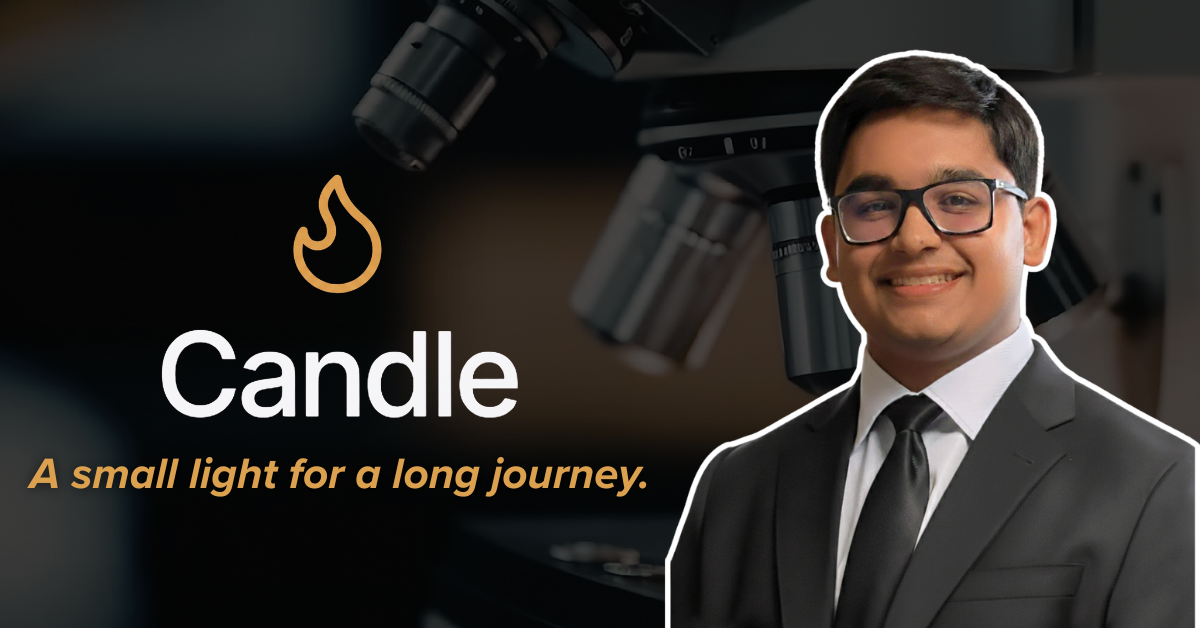
Tanish Misra, developer of Candle, a patient-developed resource platform for choroideremia (CHM). The platform integrates clinical trials and published research into a single accessible resource under the guiding theme, “A small light for a long journey.”
Patient-developed platform brings clinical trials, scientific literature and AI-powered research tools together in one accessible resource for the CHM community
SPRINGFIELD, MA, UNITED STATES, June 9, 2026 /EINPresswire.com/ -- The Choroideremia Research Foundation (CRF) is highlighting Candle, a new online resource hub designed to make choroideremia (CHM) research more accessible, understandable, and
easier to navigate for patients, families, researchers, and clinicians.Candle was developed by CHMer and Purdue University computer science student Tanish Misra, who created the platform after experiencing firsthand the difficulty of tracking CHM research across fragmented databases, clinical trial registries, and scientific publications.
“As someone living with choroideremia, I wanted to stay informed about research related to my condition,” said Misra. “But I kept running into the same problem. The information was scattered, difficult to understand, and hard to revisit. Candle started as a personal project to solve that challenge and grew into something built for the broader CHM community.”
Candle’s guiding idea is reflected in its mission statement: “A small light for a long journey.” The platform was designed to bring clarity and accessibility to complex research, helping users engage with scientific progress in a more connected and usable way.
Built by someone living with choroideremia, Candle aggregates clinical trials and peer-reviewed publications into a centralized, searchable resource grounded in real data and designed for everyday use.
A SINGLE DESTINATION FOR CHM RESEARCH
Candle features three core sections:
Trials compiles CHM-related clinical trials from ClinicalTrials.gov and presents them with structured summaries and plain-language explanations to help users understand each study without needing to interpret complex scientific documents. The section also includes an interactive timeline that visualizes the progression of CHM research over time.
Literature organizes peer-reviewed publications from PubMed, offering structured summaries, key metadata, and cross-links to related clinical trials when available.
Ask is a retrieval-augmented AI research assistant that answers questions strictly using indexed clinical trials and peer-reviewed literature within Candle. Every response includes citations to source material, ensuring transparency and verifiability. The system is intentionally scoped to research content and does not provide medical advice, diagnoses, or treatment recommendations.
A daily automated pipeline keeps the platform continuously updated by ingesting new research data, generating embeddings, and refreshing summaries without manual intervention.
Candle is open source and available at: www.candleforchm.org
The platform has also been added to the Choroideremia Research Foundation website under the Research section at: www.curechm.org/candle-chm-resource-hub
BUILT WITH THE COMMUNITY, FOR THE COMMUNITY
After developing an initial version of Candle, Misra shared the platform with CRF leadership, including Executive Director Kathi Wagner, Engagement Director Cory MacDonald, and Chief Scientific Officer Dr. Mike McConnell. Early feedback helped refine both the accuracy and usability of the tool.
A key focus that emerged during this collaboration was accessibility for users with significant visual impairment.
“The platform was built for people affected by choroideremia, but I hadn't fully considered how many users would rely on screen readers and assistive technologies,” said Misra. “That feedback changed how I approached every part of the system.”
Through CRF’s network, community members Brian Counter, Lin Ogg, and Sheldon Lewis volunteered their time and expertise to evaluate Candle’s accessibility using the screen readers they rely on daily, including NVDA and JAWS. Their feedback identified critical usability issues that would not have been apparent in standard testing.
Their contributions led to significant accessibility improvements across the platform, including:
- Improved screen reader labeling for interactive elements
- Enhanced keyboard navigation and focus management
- Fixes to modal behavior and accessibility announcements
- Expanded filtering options for assistive technology compatibility
- System-wide refinements to improve consistency and usability
Their involvement helped ensure Candle is not only informative, but meaningfully usable for members of the community it is designed to serve.
ENSURING ACCURACY, SAFETY, AND TRUST
Throughout development, Candle underwent multiple rounds of refinement to improve data quality, safety, and reliability.
Early versions of the platform surfaced unrelated clinical trials due to broad keyword matching in external APIs. To address this, a stricter pre-ingestion filtering system was implemented to ensure only trials explicitly relevant to choroideremia are included in the database.
The AI-powered “Ask” feature was also redesigned after testing revealed it could inadvertently produce recommendation-style responses. The system was rebuilt with stronger safeguards, expanded detection patterns, and post-processing checks to ensure responses remain strictly informational and citation-based.
The Ask interface was also updated with clearer scope explanations and example prompts to help users better understand what types of questions it is designed to answer.
“These systems were designed to support understanding of research, not to replace medical guidance,” said Dr. Mike McConnell, Chief Scientific Officer at CRF. “Maintaining that distinction is essential for patient safety and trust.”
EXPANDING ACCESS TO RESEARCH
For many families affected by choroideremia, research updates can be difficult to follow due to technical language, fragmented sources, and the rapid pace of scientific progress. Candle aims to reduce these barriers by centralizing information and presenting it in a more accessible and navigable format.
“This project represents what happens when lived experience meets technical skill,” said Wagner. “Tanish identified a real need, built a solution, and worked closely with the community to ensure it truly serves those it was intended to help. We are proud to support and share this resource with the broader CHM community.”
Candle will continue to evolve based on community feedback and ongoing collaboration with the CRF.

No comments:
Post a Comment