
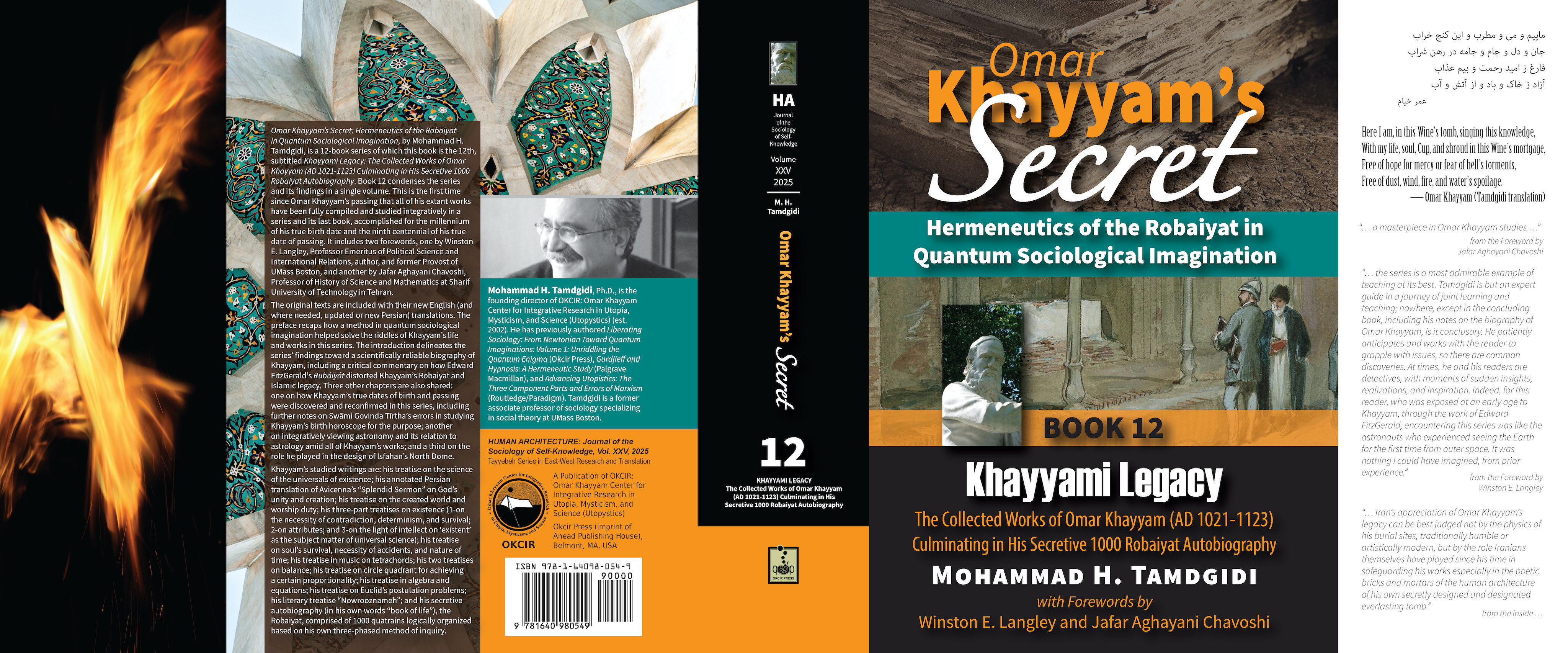
To be Published on June 10, 2025 — Book 12: Khayyami Legacy: The Collected Works of Omar Khayyam (AD 1021-1123) Culminating in His Secretive 1000 Robaiyat Autobiography
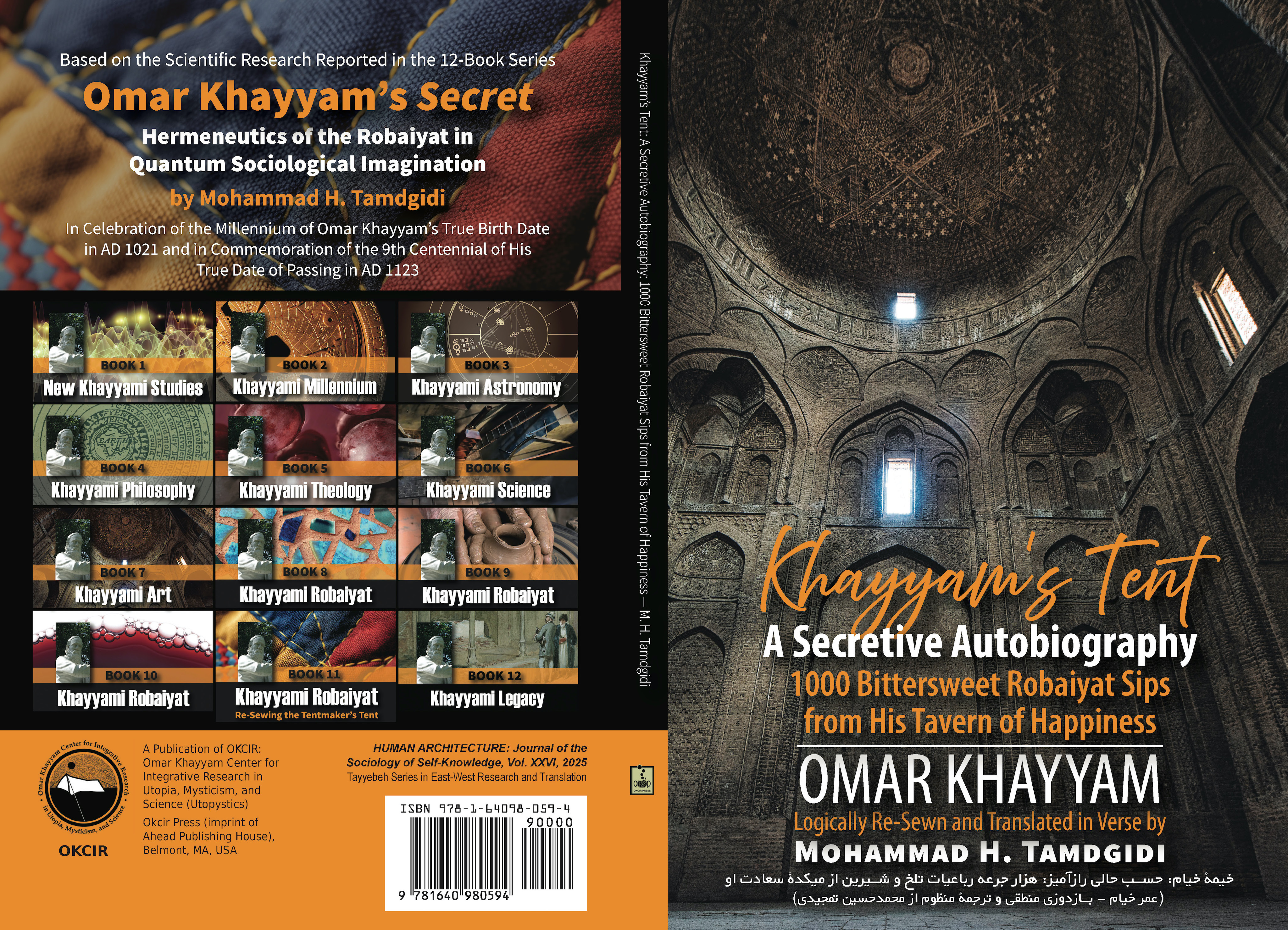
Also to be Published on June 10, 2025 - Khayyam’s Tent: A Secretive Autobiography: 1000 Bittersweet Robaiyat Sips from His Tavern of Happiness — by OMAR KHAYYAM (Logically Re-Sewn and Translated in Verse by Mohammad H. Tamdgidi)
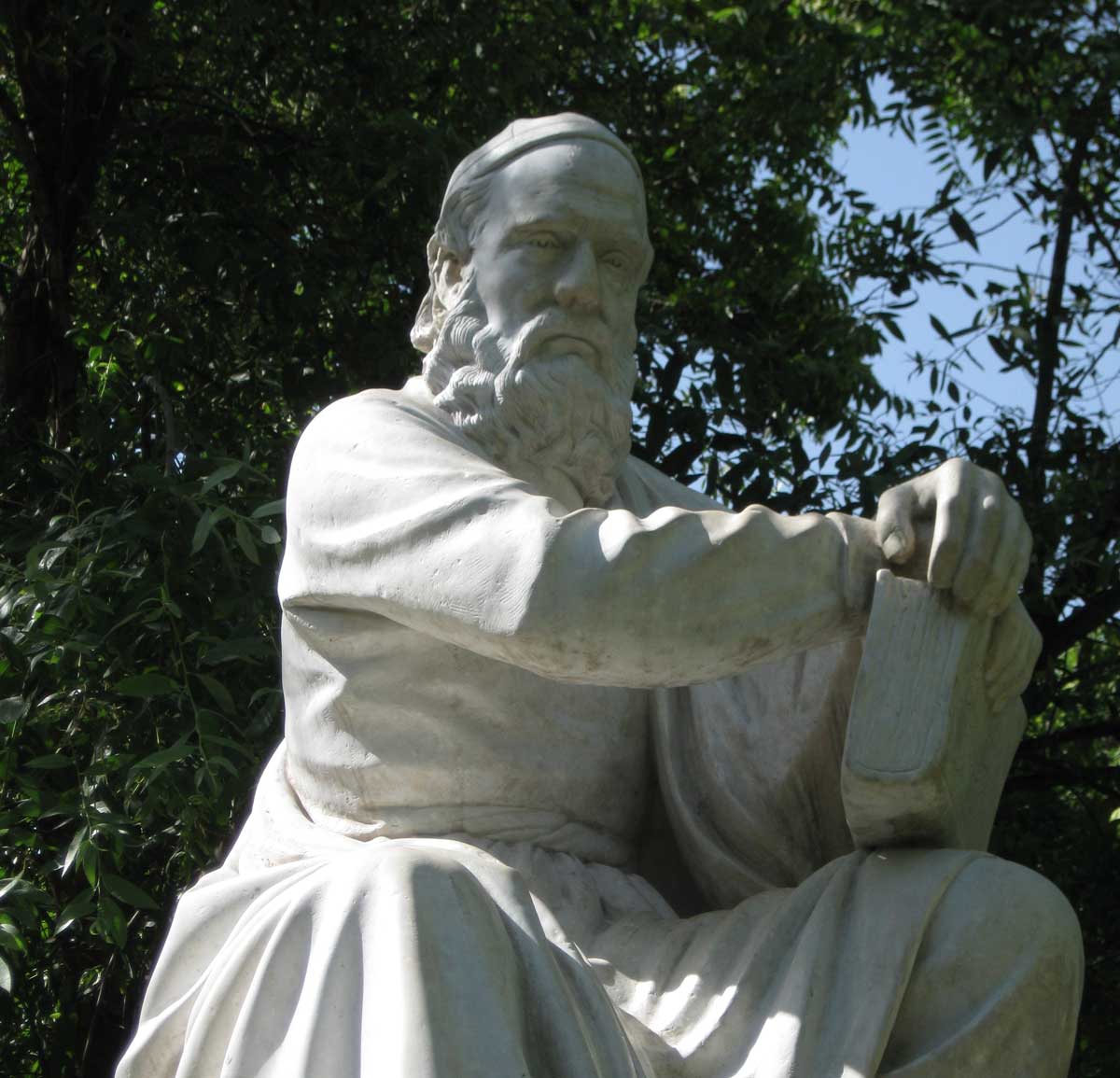
Omar Khayyam Statue, Laleh Park, Tehran, Iran
The last book of the 12-volume series "The Secret of Omar Khayyam: The Message of the Rubaiyat in the Thought of the Particle-Wave Sociology" includes the totality of his works that culminated in the logic of a thousand quatrains according to his condition.
GREATER BOSTON, MA, UNITED STATES, May 17, 2025 /EINPresswire.com/ -- The latest book in the "The Secret of Omar Khayyam" series, "Khayyam's Legacy: The Totality of Omar Khayyam's Works (1021-1123 CE), Culminating in a Thousand Quatrains According to His Mysterious Present", will be published on June 10, the true anniversary of his birth. This
is the first time after Khayyam's death that all his works have been collected in a collection and studied in a unified manner. The book consists of two prefaces, one by Dr. Winston E. Langley is a retired professor of political science and international relations and former faculty director (Provost) at the University of Massachusetts in Boston, and the other is Dr. Jafar Aghayani Chavoshi, a professor of philosophy of science at Sharif University of Technology in Tehran and an expert in epistemology and history of mathematics and science and Khayyam studies.
The 12-by-1200-page book contains Khayyam's treatises with a new English translation (and, if needed, an updated or new Persian translation). The preface explains the particle-wave sociology method used in solving the riddles of Khayyam's life and works in this collection. The introduction outlines the findings of this collection, which are necessary for the scientific explanation of Khayyam's biography, and criticizes the role of Edward Fitzgerald in the colonial distortion of Khayyam's Islamic heritage and his quatrains. In addition to Khayyam's works, three other chapters deal with the following topics: one on how to discover the correct date of birth and reaffirm the true date of Khayyam's death in this collection, including further explanations of Swami Govinda Tirtha's mistakes in studying Khayyam's horoscope for this purpose, another on the necessity of looking at all of Khayyam's works from the perspective of astronomy and astronomy, and the third on the role that Khayyam played in the design of the northern dome of Isfahan He did.
Khayyam's works that have been studied in books and collections include: his treatise on the science of the generalities of existence, his Persian translation of Ibn Sina's brilliant sermon on monotheism and creation, his treatise on the world of creation and the obligation of worship, his triple treatises on existence (1) on the necessity of contradiction, determinism, and survival, 2) in the descriptions, and 3) on the light of the intellect on the "being" as the subject of the science of generalities), his treatise on the survival of the soul, the necessity of events, and the nature of time, his treatise on music on the four commodities, his two treatises on the scale, his treatise on the quarter of a circle for the attainment of a definite proportion, his treatise on algebra and confrontation, his treatise on problems in the originalities of Euclid's book, his literary treatise "Nowruznameh", and according to his mysterious situation, which includes a thousand quatrains that are logically arranged according to his own three-step research method.
Khayyam uses the term "letter of life" or "according to the present" for biographies. In fact, the most important finding of this research is that Khayyam was busy writing according to his mood in the form of mysterious quatrains for the rest of his life, so that the abstract of the wisdom of all his works would be sewn in that poetic tent, with the intention that it would be published after his death. This is the reason why his contemporaries were not aware of it, and unfortunately, after his death, his quatrains were scattered due to natural disasters, barbaric attacks by foreigners, and the inclusion of alphabetical poems, but thanks to the intellect, hearts and hands of his compatriots, writers, and lovers, they were preserved and survived throughout the centuries.
His pseudonym "Khayyam" was his literary pseudonym and inspired by his wonderful fortune. The re-enactment of his quatrains in this collection, which was in fact the restoration of his tent of wisdom as a repository that presents the spiritual wine of his poetry, now makes it possible to read it in the most sincere way. However, the quatrains are not only personal but from a sociological point of view, they are a poetic narrative of man's attempt to heal himself spiritually in search of true happiness.
Iran's tribute to Omar Khayyam's legacy should be based not only on the simple or modern architecture of his tomb, but also on the role played by Iranians throughout the ages in preserving his works, especially in the poetic clay and mortars of the tomb's architecture.He judged the eternity that he himself designed in his quatrains.
Dr. Jafar Aghayani Chavoshi, one of the pioneers of scientific tentology in Iran, writes in his preface to this concluding book: "... At the very beginning, after a general review of the first volume of the collection, I told him that I consider this book a masterpiece in Khayyam research... After receiving the continuation of Dr. Tamjidi's works about Khayyam, I believe that all of these works are admirable, and in my opinion, only love for Iran and Khayyam can be the reason for his works related to Khayyam. ... No one can fail to admire Dr. Tamjidi's tireless efforts in reintroducing Khayyam to the world..."
Dr
. Winston E. In his preface to the concluding book of the collection, Langley writes: "After eleven books in his collection, in the twelfth book, a praise, like a good teacher, reviews what was previously contained in this collection. Then, he examines the needs for scientific advancement of research in Khayyam's biography and then draws the new findings of this collection in order to achieve a more texturally and historically reliable biography for Khayyam. ... This collection is an admirable example of the best educational processes. Tamjidi is not only an outstanding guide in joint learning, but nowhere at all, except in the final book, even in his notes on Khayyam's biography, does he show his definitive conclusions at once. He patiently accompanies the reader so that together they can experience the sudden moments of new discoveries like the footprints of curious seekers. In fact, for me, who became acquainted with Khayyam's quatrains from the perspective of Edward Fitzgerald at a young age, the encounter with this collection was like the experience of astronauts who observed the earth from space for the first time. Such an experience was unimaginable for me beforehand."
"I told him what Khayyam said / He said how long it is going"
- Omar Khayyam
——————————————————————— Dr
. Mohammad Hossein (Behrouz) Tamjidi is the founder of Elixir: Omar Khayyam's Center for Integrated Research in Utopia, Mysticism and Science (Mysticism) (www.okcir.com) and a former associate professor of theorizing in sociology at the University of Massachusetts in Boston.

No comments:
Post a Comment